“It’s our polite nudge in the ribs to help you and your team stay organised and on task.”
This week’s subject is Resources support play based learning.
Element 3.2.2: Resources, materials and equipment allow for multiple uses, are sufficient in number, and enable every child to engage in play-based learning.
How intentionally does your service provide open-ended resources and create environments that encourage children to engage in appropriately measured risky play, empowering them to explore, problem-solve, build resilience and confidently test their capabilities while ensuring safety remains paramount?
Element 3.2.2 highlights that high-quality resources are flexible, open-ended and responsive to children’s interests, enabling them to investigate, imagine, create, collaborate and challenge themselves through play. When combined with thoughtfully designed environments, these resources become powerful tools that promote competence, exploration and increasingly complex learning experiences. The physical environment truly becomes the child’s “third teacher”, intentionally provoking curiosity, inquiry and confident risk-taking.
The Risky Play Position Statement for Young Australian Children defines risky play as “ play that is exploratory and challenging with often unpredictable outcomes. It is child-initiated and physically engages all the senses leading to positive learning and developmental outcomes.”
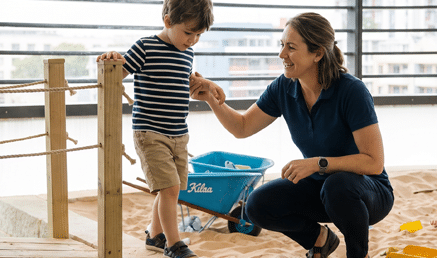
Risky play provides opportunities for children to assess challenges, make decisions, manage uncertainty and gradually extend their own capabilities. Research consistently demonstrates that when children engage in appropriately measured risky play, they develop resilience, perseverance, confidence, executive functioning, problem-solving skills, spatial awareness, self-regulation and sound risk assessment skills that support lifelong learning. Educators play a critical role in creating environments where children can safely experience challenge, rather than eliminating every element of risk.
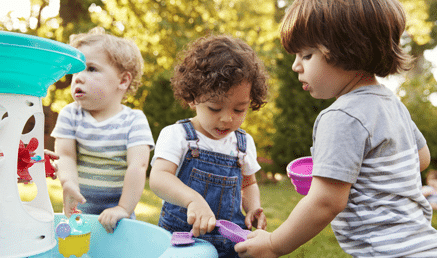
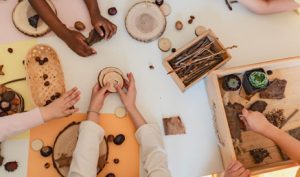
Open-ended resources are central to achieving this balance. Unlike single-purpose equipment, loose parts, natural materials and versatile resources invite children to decide how they will be used, encouraging creativity, experimentation and collaboration. Logs may become balance beams, stepping stones or bridges; crates may transform into obstacle courses, vehicles or dramatic play settings; planks, tyres, ropes, pipes, stones and fabric can be continually reimagined by children as their ideas evolve. Because these materials have multiple possible uses, they naturally encourage children to test ideas, solve problems and negotiate challenges together while engaging in meaningful play-based learning.
Educators intentionally support risky and open-ended play by observing children’s interests, strengths and emerging capabilities through the planning cycle. Ongoing observation, assessment and critical reflection help educators determine when to introduce additional challenge, when to scaffold learning and when to step back, allowing children to independently assess and manage risks for themselves. Rather than directing play, educators remain present, responsive and intentional, using thoughtful questioning, modelling safe practices where appropriate and recognising when children are capable of solving problems independently.
Services support play based learning by:
-
- intentionally providing a wide variety of open-ended resources including loose parts, natural materials, recycled materials and construction resources that children can use in multiple ways
- regularly reviewing learning environments to ensure resources offer varying levels of challenge that respond to children’s individual interests, strengths and developmental capabilities
- incorporating natural elements such as logs, rocks, pebbles, tree stumps, uneven terrain, gardens and climbing opportunities that support appropriately measured risky play
- using risk-benefit analysis when introducing new resources or environments to balance developmental benefits with children’s safety
- rotating and repositioning resources to maintain curiosity, sustain engagement and encourage new ways of thinking and problem-solving
- observing how children use resources and adapting environments to extend emerging skills, confidence and independence
- ensuring educators adopt a consistent, service-wide understanding of the difference between acceptable risk and unnecessary hazards and uphold a commitment to maintaining a child safe environment
- intentionally using open-ended questioning to encourage children to predict, plan, test ideas, reflect on challenges and evaluate their own risk-taking decisions
- documenting children’s learning through risky and open-ended play, highlighting growth in resilience, persistence, collaboration, confidence and problem-solving
- partnering with families to share the educational benefits of risky play and detail how the service intentionally manages safety while supporting children’s competence, development and wellbeing.
When educators thoughtfully combine open-ended resources with appropriately measured opportunities for challenge and risk, they create environments where children are trusted as capable and competent learners. These environments foster creativity, resilience, confidence and independent thinking while supporting children to develop multi-dimensional risk management competencies, solve increasingly complex problems and develop a strong sense of agency. By intentionally balancing challenge with safety, services create rich learning environments where play becomes the foundation for lifelong learning, wellbeing and confident participation in their world.
Resources:
Guide to the NQF: Standard 3.2- Use, Element 3.2.2: Resources support play-based learning
ACECQA information sheets: BELONGING,BEING & BECOMING: Play based learning and intentionality, QA 3 Information sheets
Play Australia– Risky play resources
The Sector- Practising essential risky play safely in ECEC settings
Within System7 go to Quality Area 3/Modules 9 and 10 to submit self-assessment notes and if required, open a QIP issue if you identify any areas of improvement.
Within QIP Desk go to element 3.2.2 to submit your key practices and if required, create a QIP Goal for areas of improvement.
The Desktop has a range of resources to assist services with play-based learning. These include Educational Program Policy, Assessment and Planning Cycle Guide and Procedure, Physical Activity Policy, Physical Environment Policy, Risk Assessment Templates, Risk Assessment Guide and Procedure, Safety Checklists, Adventurous (Risky and Nature) Play Policy and much more.
Resources, NQS Element, Regulation and System7 links:
The Desktop – The Desktop
National Quality Standard – QA 3/ 3.2.2- Resources support play-based learning
National Regulations – 73 – Educational program, 105 – Furniture, materials and equipment, 113 – Outdoor space—natural environment
System7 Module – QA 3/Modules 9 and 10
If you have any questions, send us a note via the Contact page here!